Most guides to coffee cup reading are lists. A bird means news, a fish means luck, a snake means someone is not being straight with you. Useful up to a point, and then you turn a cup over and find a bird, and immediately wonder: does it matter that it is down near the base rather than up by the rim?
It does. In the tradition, where a shape sits is doing at least as much work as what the shape is. The cup is treated as a small map, with the handle as its landmark, and learning that map is what turns a list of symbols into an actual reading.
First, the Cup Has to Be Prepared Properly
None of the geography works if the grounds never settle into a readable state.
The drinker finishes the coffee, leaving the thick sediment and a little liquid at the bottom. A saucer goes over the top, and the whole thing is turned over in one motion, away from the body. Then it is left alone.
The waiting is the part people rush. The cup needs to cool completely, often ten minutes or more, because the reading is in the dried tracks the grounds leave as they run down the sides. Lift it early and the patterns are still wet and shapeless. Traditionally a coin is placed on the upturned base while it cools, a gesture meant to keep any difficult reading at bay.
When the cup is cold, it is lifted straight up. Whatever is on the inside is the reading.
The Handle Is You
Every convention starts from the handle. It represents the person whose cup it is, so the reading is oriented around it the way a map is oriented around north.
Shapes close to the handle concern you directly and concern now: your home, the people in your house, what is immediately in front of you. As symbols sit further around the cup and away from the handle, they are read as further from you, either in relationship or in time. A figure on the far side is a stranger, a distant matter, or something further out.
Many readers also treat the handle side as the territory of the heart and close relationships, and the side opposite the handle as the territory of work and material matters. Conventions vary between readers and between families, which is worth saying plainly. There is no single authorized chart, and anyone who tells you there is has overstated it.
Rim, Middle, and Bottom: How Time Is Read
This is the most consistent piece of the geography, and the most useful one to learn.
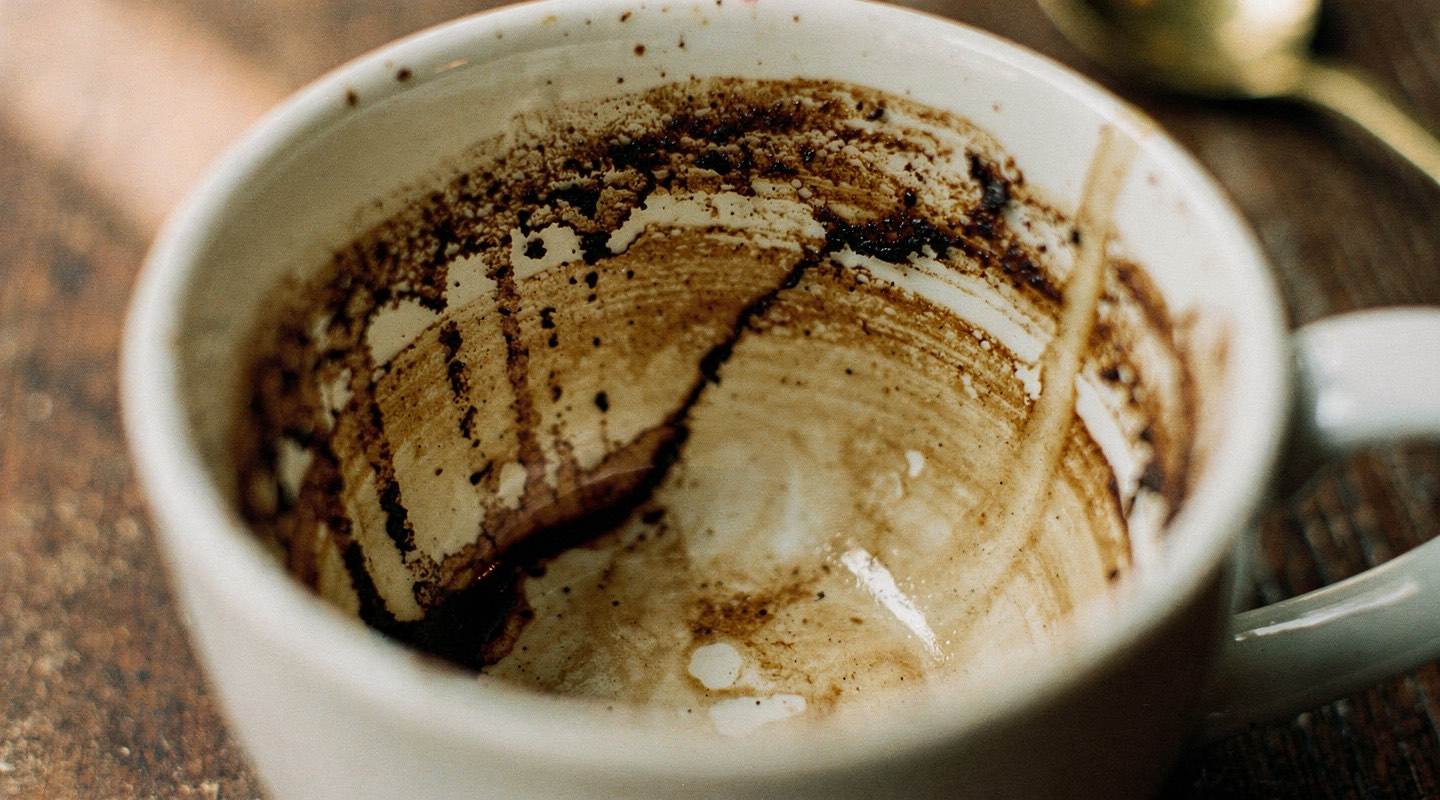
- The rim is the near term. Shapes at the top edge are read as what is rising, arriving, or already in motion.
- The middle is the medium term, and often the body of the reading. Most of what a reader talks about lives here.
- The bottom is the past, or things settling and fading. A heavy dark mass at the base is usually read as something being left behind rather than something coming.
Some readers extend this into rough timing, treating marks near the rim as days and marks toward the middle as weeks. Treat that lightly. The honest version of the tradition is that the cup describes a direction of travel, not a calendar.
A dense band of grounds all around the rim is often read as a busy or crowded period. A cup that comes out mostly clean, with only a few clear marks, is generally taken as a settled stretch rather than an empty one.
Which Way You Read It
Start at the handle and work around, and be consistent about the direction. Most readers move away from the handle in one continuous sweep, treating the journey around the cup as a journey outward in time and distance.
Do not try to catalogue everything. A cup contains far more marks than any reading uses, and the practice is to notice what actually stands out: the clearest shape, the largest mass, the one line that runs somewhere. If you find yourself squinting to make a shape appear, it is not there.
The best readers are also the least definitive. They describe what they see, offer what it traditionally suggests, and leave room for the person holding the cup to recognize something or not.
What About the Saucer?
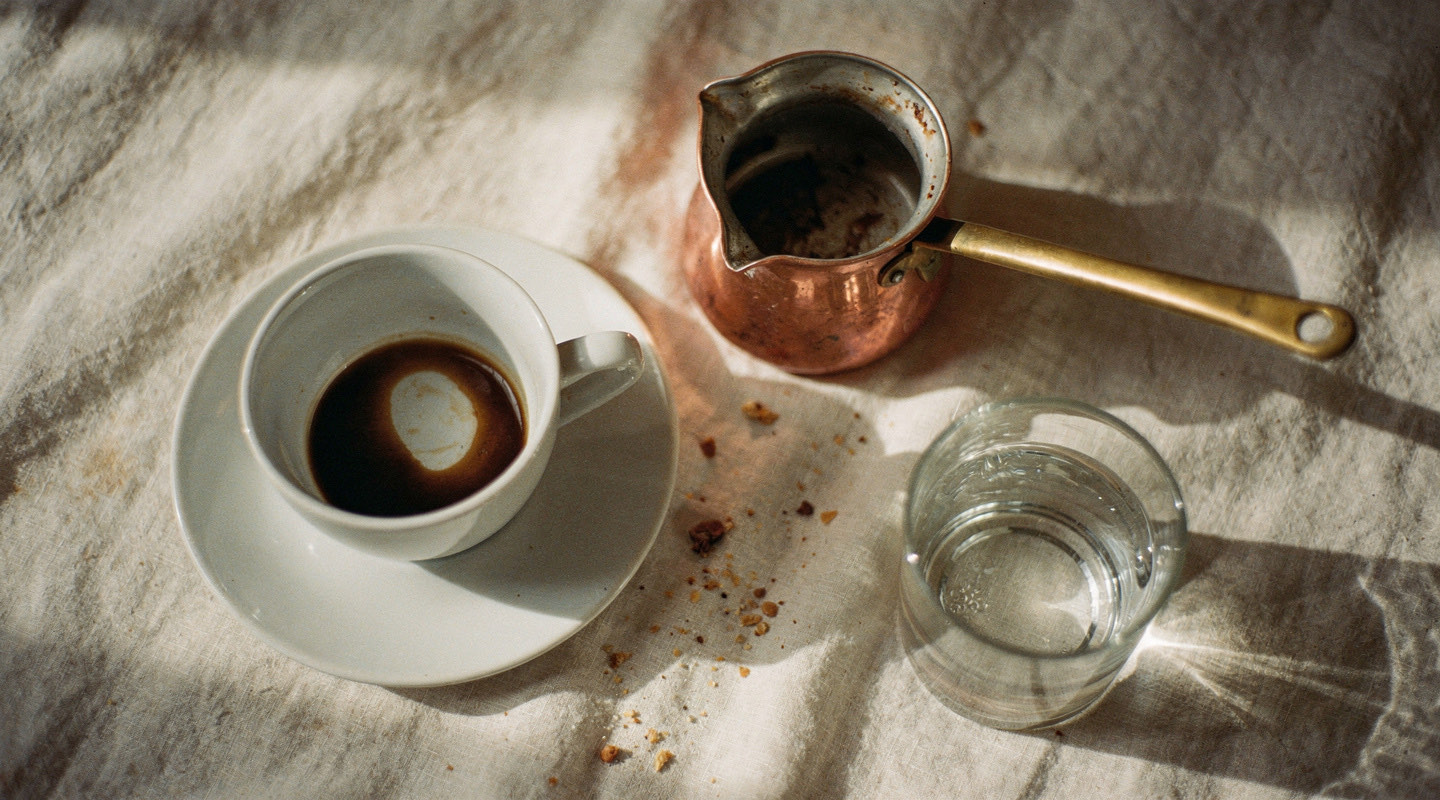
The saucer is not a spare. When the cup is lifted, whatever ran out onto the plate is part of the reading.
The usual interpretation is that the saucer holds what is leaving: matters resolving, worries draining away, things moving out of your life rather than into it. A large flow onto the saucer is generally read as release, and a clean saucer means the story stayed in the cup.
Some readers also press a thumb into the grounds at the bottom of the cup at the end and read that impression as a wish, or as the heart of the matter. Like much of this, it is a family custom in some households and unknown in others.
Holding It Lightly
Here is the part that matters more than any of the geography above.
A coffee cup does not know your future. What the tradition offers is a structured way to sit with someone for twenty minutes and talk about their life through the safe distance of a symbol. That distance is the useful bit. People say things about a shape in a cup that they would not say directly, and the reader gets to raise something gently, as a possibility rather than a claim.
Read this way, the cup is a conversation starter with several centuries of practice behind it, and the map of handle, rim, and base is simply the shared vocabulary that makes the conversation flow. If you want the fuller picture of the individual shapes, what the symbols in the cup traditionally mean covers the vocabulary itself, and tea leaf reading works from very nearly the same instincts in a different cup.
None of it works without a proper cup of coffee underneath, of course, which means the classical cezve method and enough sediment to read. If your cups have been coming out thin lately, the usual reasons the foam fails are worth a look first.
May your cup be interesting, whatever you decide it means.